Desirable Kitchens and Refacing logo
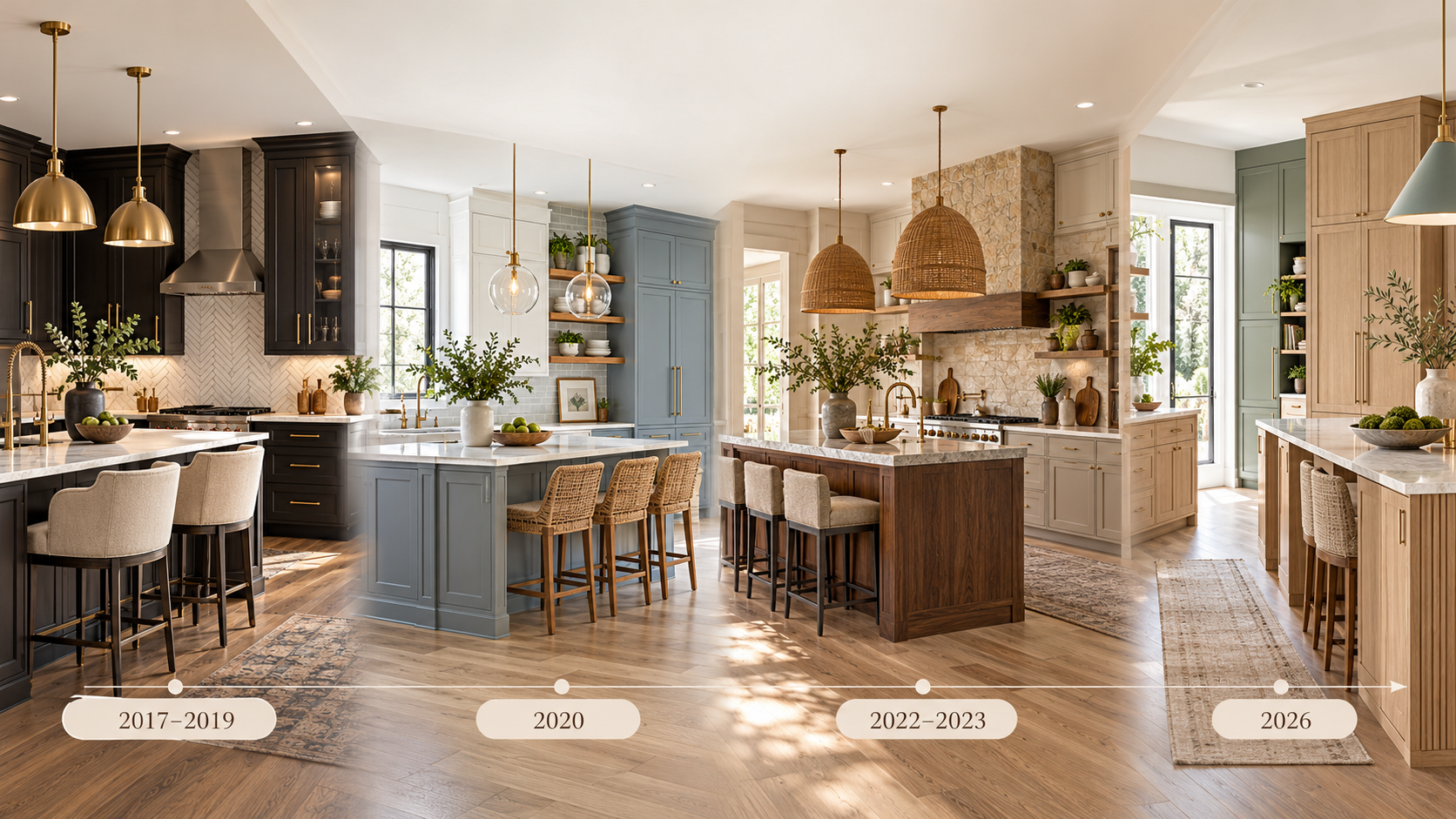
Kitchen cabinet trends have changed significantly over the years. White cabinets, dark wood finishes, gray kitchens, two-tone designs, and colorful doors have all been popular at different times. Many of these styles remain popular, though the colors, finishes, and details have evolved.
In 2026, homeowners are considering natural wood finishes, softer neutrals, simple cabinet doors, and practical storage.
For Pittsburgh homeowners with outdated cabinets, the good news is you don’t always need a complete replacement to update their look.
Cabinet refacing can update your kitchen’s color, door style, and visible finishes while keeping structurally sound cabinet boxes in place. It’s an option worth exploring if you like your kitchen’s existing layout but want a different look.
At Desirable Kitchens & Refacing, we serve Pittsburgh and Western Pennsylvania, helping homeowners explore cabinet updates that work with their existing spaces. Looking back at past kitchen cabinet trends can help you decide which styles to keep and which 2026 ideas might work in your home.
Kitchen cabinet trends tend to evolve rather than disappear completely. A color or finish popular a few years ago may return in a slightly different form. Traditional and contemporary styles also continue to overlap.
We’ve covered these changes in our kitchen design articles over the years. Here’s how some of those trends developed.
In our 2017 article on top kitchen trends, we highlighted greige, a combination of gray and beige, as an alternative to traditional white kitchens.
The article also discussed black-and-white color schemes, chrome and nickel accents, and customized storage solutions. These ideas reflected an interest in comfortable kitchens with coordinated finishes and practical features.
By 2019, our kitchen trend coverage explored darker colors, including navy, black, and forest green.
Two-tone cabinets were another design direction. Homeowners could pair white cabinetry with wood elements or choose different colors for upper and lower cabinets. Mixed metals, including black, copper, pewter, and brass, also appeared in kitchen designs.
Several of these ideas remain relevant today, particularly darker accent colors and contrasting cabinet finishes.
Our 2020 article on kitchen cabinet trends discussed styles that are still familiar today. Shaker cabinets offered a simple, adaptable look, while slab doors appealed to homeowners interested in cleaner lines. White, gray, blue, and two-tone cabinetry also made the conversation.
A separate article on popular kitchen cabinet colors of 2020 covered earthy greens, navy, warm ivory, charcoal, and natural wood. Interestingly, the two articles offer different perspectives on wood finishes. One discusses a shift away from certain wood-grain looks, while the other highlights interest in natural finishes.
This illustrates why cabinet trends shouldn’t be treated as strict rules. Different colors, materials, and styles can appeal to homeowners at the same time.
By 2022, the design conversation shifted toward kitchens that felt comfortable and worked well for everyday use.
Our article on seven kitchen remodeling trends for 2022 explored natural materials, understated finishes, personalized storage, and the importance of coordinating kitchen details.
Our 2023 coverage continued several of these themes.
Our article on kitchen design trends, according to professionals, discussed islands, statement backsplashes, and color-and-wood combinations.
Another article on 2023 cabinet trends highlighted dark wood, clean cabinet lines, storage improvements, and distinctive hardware.
Our 2023 cabinet color guide also covered warm whites, taupe, natural wood, deep blues and greens, and two-tone designs.
Taken together, these articles show that many of today’s cabinet ideas have been part of kitchen design for years.
White cabinetry, natural wood finishes, simple door profiles, and carefully chosen accent colors can all work in today’s kitchens. The best choice fits your home’s existing materials, lighting, and overall style.
For example, white cabinets can complement darker countertops or traditional flooring. Wood finishes can add warmth to a kitchen with neutral walls, while a blue island can add contrast without painting every cabinet a bold color.
Door style also affects the overall appearance. A Shaker door can work in traditional or contemporary kitchens, depending on its finish, hardware, and surrounding materials.
Before choosing a new color or door profile, consider the parts of your Pittsburgh kitchen you plan to keep. Countertops, flooring, backsplash materials, wall colors, and natural light can all influence how a finish looks once it’s installed.
You may also find your cabinets need only a style change, not a completely different color scheme. Here are a few hypothetical examples of how refacing can update older cabinet styles.
| Earlier cabinet choice | What you may want to update | Refacing option to discuss |
|---|---|---|
| Dark wood with detailed doors | A simpler appearance | Replacement doors with cleaner profiles |
| Bright white cabinetry | A warmer color palette | Warm white or soft neutral finishes |
| Cool gray cabinets | A more natural appearance | Taupe or wood-look options |
| Traditional raised-panel doors | Less decorative detailing | Shaker or other simple door styles |
| One cabinet color throughout | More contrast | Coordinated two-tone finishes where feasible |
These are examples, not descriptions of completed customer projects. Available materials and your cabinets’ condition will determine which options are suitable.
Yes. Professional cabinet refacing can change both your cabinet color and door style without replacing the existing cabinet boxes, as long as the boxes are in good condition. Rather than removing the entire cabinet system, refacing updates the components you see.
We explain our cabinet refacing process on our website. The process includes removing existing doors and drawer fronts, preparing exposed cabinet surfaces, and installing replacement components.
Cabinet face frames, sides, and other visible areas are finished to coordinate with the new doors and drawer fronts. You can also incorporate matching trim, hinges, and hardware.
This is different from painting the doors you already have. Refacing lets homeowners choose a different door profile, plus a new color or finish.
However, refacing isn’t appropriate for every kitchen. Your cabinet boxes should be structurally sound, and the existing layout should generally meet your needs. If the cabinets are significantly damaged or you want major layout changes, replacement may be a better option.
We discuss these considerations in our guide to refacing versus replacing cabinets.
If you’re considering cabinet refacing in Pittsburgh, a professional evaluation of your existing cabinets can help you decide which approach makes sense.
Natural wood finishes, warmer neutrals, simple cabinet doors, and practical storage are among the kitchen design directions receiving attention in 2026.
For homeowners considering cabinet refacing, these trends offer ideas for updating an existing kitchen without necessarily replacing the cabinet boxes. The key is choosing colors, finishes, and features that suit your space, rather than following a trend just because it’s popular.
Wood cabinetry is receiving renewed attention in national kitchen remodeling research.
According to the 2026 U.S. Houzz Kitchen Trends Study, 29% of surveyed homeowners planning renovations selected wood cabinetry, compared with 28% who selected white. That narrow difference is worth noting. Wood has edged out white in the survey, but white cabinetry remains a widely chosen option.
Natural-looking wood finishes can work in several kitchen styles. Lighter tones suit a kitchen where you want a softer look, while medium or darker finishes complement stone countertops, tile, and contrasting painted surfaces.
If you’re interested in bringing wood finishes into your kitchen, refacing may offer an option. You can discuss replacement doors with wood or wood-look finishes and coordinating materials for exposed cabinet surfaces.
Before settling on a particular finish, ask us which wood species, veneers, colors, and matching materials we currently offer.
Warm neutrals, greens, and blues also feature in the 2026 kitchen design conversation.
The National Kitchen & Bath Association’s 2026 Kitchen Trends Report identified neutrals, greens, and blues as prominent color directions among surveyed industry professionals.
These findings reflect broader kitchen design expectations, not the cabinet colors Pittsburgh homeowners selected. For your own kitchen, consider warm white, soft taupe, or muted green.
Warm white cabinets can coordinate with existing wood flooring or warmer countertops. Muted green offers an alternative to traditional neutrals, while blue may work as an accent on an island or selected cabinetry.
You don’t necessarily need to choose one color for every cabinet. A two-tone design may be worth discussing if your kitchen has an island or another area that could support a contrasting finish.
The most useful way to evaluate these choices is to compare samples in your kitchen.
Natural light, artificial lighting, flooring, and countertops can all change how a color appears. Seeing samples in the room can help you decide whether a particular shade works with the materials you’re keeping.
Cabinet door styles can make a noticeable difference even when the cabinet layout stays the same. The NKBA’s 2026 research identifies flat slab cabinet doors as a design feature expected to gain popularity.
Slab doors have a flat surface without a raised or recessed center panel. Their simple look complements contemporary kitchens, especially when paired with understated hardware and coordinated finishes.
Shaker doors are another option for homeowners who want clean lines with some traditional detail.
Refacing an ornate or raised-panel door to a simpler profile can change your kitchen’s look while keeping the cabinet boxes.
One detail to keep in mind: a slab door is a door style, not a cabinet construction method. Installing slab doors doesn’t automatically convert framed cabinets into frameless cabinetry.
The right door profile will depend on your existing cabinets, personal preferences, and available replacement styles.
Kitchen design in 2026 isn’t just about appearance. Storage and everyday functionality are also important parts of the discussion.
NKBA research points to interest in organized kitchens, extra drawer storage, and spaces designed around household needs.
If you’re already considering new cabinet doors and finishes, it may make sense to review how well your current storage works.
On our website, we list optional improvements and additional storage solutions, including drawer upgrades, pantries, islands, and lazy susans.
For example, you may want drawers that operate more smoothly, easier access to items in deep cabinets, or more space for frequently used kitchen supplies.
Some improvements may be possible within existing cabinetry. Others could require additional cabinets or work beyond standard refacing.
Not every storage accessory fits every cabinet, so discuss these options during the project assessment.
Considering storage alongside your cabinet finishes can help you plan an update that addresses both appearance and everyday use.
Looking back at kitchen cabinet trends from 2017 through 2026 shows that styles often evolve rather than disappear.
Wood finishes, white cabinetry, darker colors, contrasting designs, and simple doors have all stayed in the conversation, just in different ways.
For your kitchen, the goal isn’t necessarily to choose the newest color or most popular door style. It’s to find a look that complements your home and keeps working for your household.
If your cabinets are structurally sound and the existing layout meets your needs, refacing may be a practical way to update their appearance.
We serve Pittsburgh, the South Hills, and surrounding Western Pennsylvania communities. We can assess your cabinets, discuss replacement doors and finishes, and help you explore available refacing options.
You can also browse our cabinet refacing gallery to see examples of completed work.
Ready to explore new cabinet colors and styles for your kitchen?
Contact us at 412-515-0582 or request a free consultation. A consultation lets you discuss your ideas, evaluate your existing cabinetry, and see which updates may work for your home.
